Volumes and Structures
Selected Works, 2014–2026
Transposed onto the cube, the Flower Squares motif is no longer purely frontal: it must contend with edges, shifting faces, and the actual depth of the support. Color then breaks apart the geometry of the volume, connecting certain forms while interrupting others. The cube remains physically intact, yet its appearance seems to fragment and reconstruct itself depending on the angle from which it is viewed.

Flower Square
12 x 12 cm
In these volumes, ricochet becomes literal: the motifs move from one face to another and use the edges as pivot points. The drawing may contradict the cube’s actual geometry, extend a direction where the volume should interrupt it, or create fictive depths. The painted surface thus constructs a new reading of the volume, superimposed onto its physical form.

Ricochet 01
12 x 12 cm

Ricochet 02
12 x 12 cm
In its three-dimensional version, Overlapping Squares brings together two kinds of depth: the cube’s actual depth and the illusory depth created by color. The opaque motifs give the impression of transparent layers passing through the different faces, making the exact position of certain forms ambiguous. The eye then hesitates between the physical construction of the volume and the virtual planes drawn across its surface.
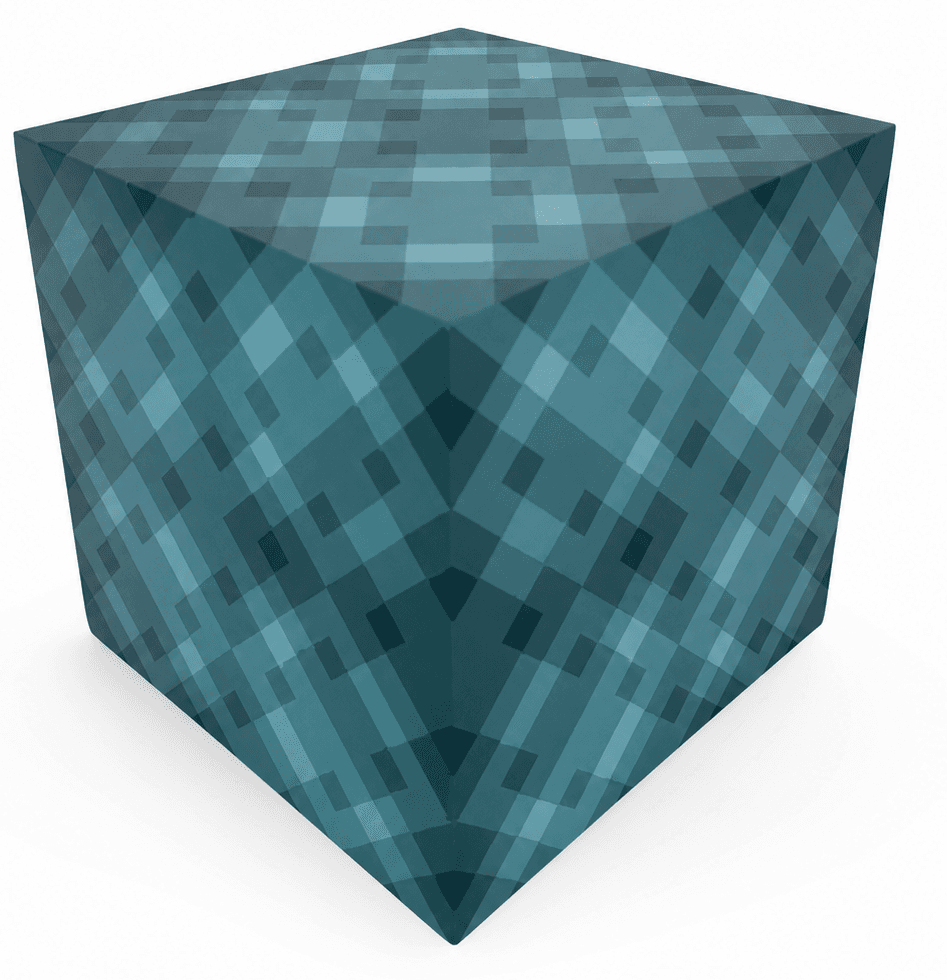
Overlapping Square
12 x 12 cm
In Divergence, the lines follow the cube only to move away from it. They branch out, change direction, extend around the angles, and create trajectories that simultaneously draw the eye toward several points. Each work thus becomes a different mapping of the same volume, built from directions that seem to continually separate and redistribute themselves.

Divergence 01
Acrylic on prepared wood
12 x 12 cm

Divergence 02
Acrylic on prepared wood
12 x 12 cm

Divergence 03
Prepared foam board
10 x 10 cm
Here, the stick becomes the elementary unit of an open structure. Through repetition, the volume is built without ever being completely enclosed: the elements stack, intersect, and change direction while air circulates freely between them. The structure takes shape as much through what is constructed as through the spaces left empty between the lines.
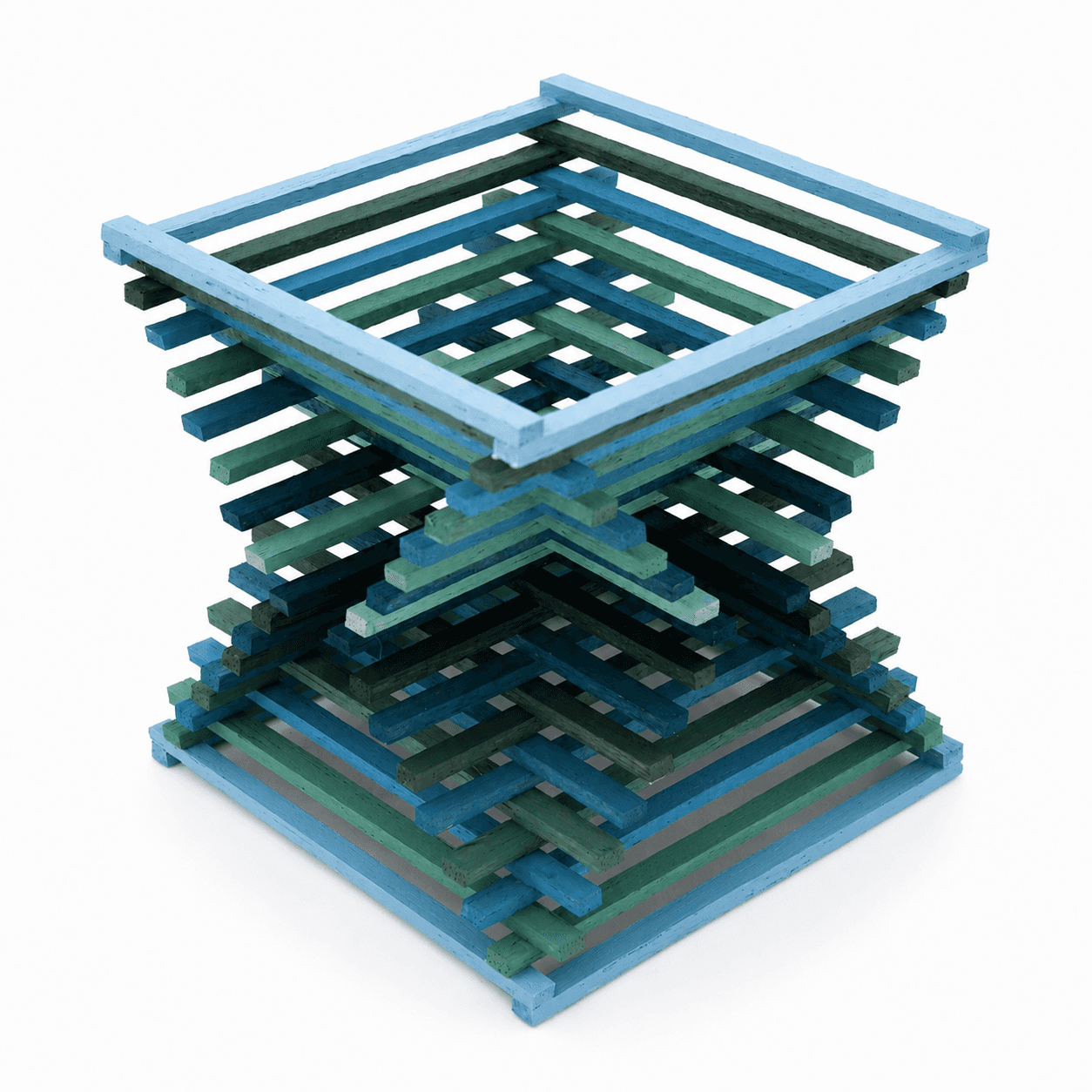
Superimposition
10 x 10 cm

Interlocking
10 x 10 cm

Deployment
11 x 11 cm
In these volumes, disappearance no longer concerns only color, but also the physical presence of the object. Chromatic gradations soften certain faces, while the construction itself seems to hesitate between plane and volume. Depending on the light and viewpoint, a boundary can become almost invisible, giving the impression that the form extends into the surrounding space.

Horizontal Stretch
Oil on prepared wood
40 x 94 cm

Volume at 90°
Oil on prepared wood
40 x 47 cm

Volume at 120°
Oil on prepared wood
40 x 47 cm

Disappearance
Oil on prepared cardboard
50 x 70 cm

Vertical Stretch
Oil on prepared wood
100 x 47 cm
The open version of Ricochet transforms visual movement into an actual circulation through space. Grids, suspended elements, and repeated structures create successive passages between matter and void. Rather than being stopped by a surface, the eye moves through the work, encounters one element, bounces toward another, and continuously reconstructs the volume as the viewer moves around it.

Grid
Acrylic on prepared wood
24 x 24 cm

Suspension
Molded porcelain powder, colored throughout
13 x 13 cm

Weaving
Acrylic on prepared wood
12 x 12 cm
In these structures, the square becomes a spatial module. Repeated, shifted, and interlocked, it forms a grid in which the openings play a role as important as the material elements. The squares change configuration as the viewer moves in front of the work: they may align, overlap, or separate, creating temporary compositions that exist only from a given viewpoint. Cast shadows also participate in this transformation, extending the forms into space and creating new relationships between matter, void, and perception.

Structure 01
24 x 24 cm

Structure 02
34 x 24 cm
Transformation begins with reclaimed materials to explore how far the form of the cube can be altered without disappearing completely. Soft, knotted, folded, accumulated, or assembled, these materials introduce their own irregularities into an initially strict geometry. From one module to the next, the cube becomes denser, opens up, or deforms, making the material itself the driving force of its metamorphosis.

Module 01
Cardboard
12 x 12 cm

Module 02
Paper napkins
6 x 6 cm

Module 03
Adhesive tape
12 cm x 12 cm