Plane and Perception
Selected Works, 2001–2026
Ricochet emerges from a shift between what actually exists on the surface and what the eye believes it recognizes. Broken lines, fields of color, and chromatic transitions create directions, reliefs, and fictive depths that seem to escape the plane of the painting. The composition acts like a wave: the eye bounces from one form to another, gradually loses its bearings, and discovers a space that exists only in perception.


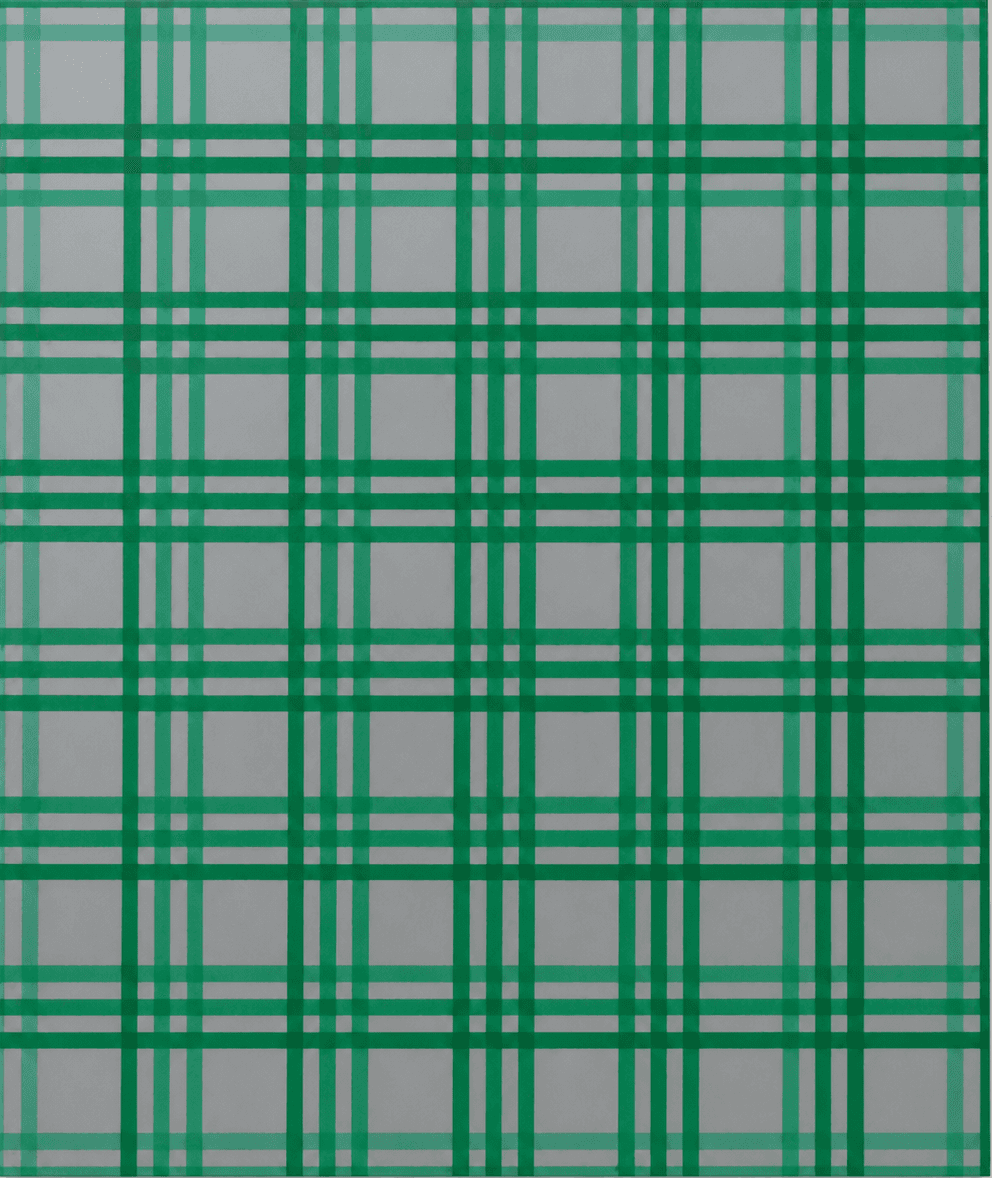
In Lines on Squares, a vertical grid overlays and disrupts the square constructions beneath it. Some forms remain visible, while others fragment or disappear behind the lines, as contrasts of color bring out successive levels of perception. The eye is no longer quite sure whether it should follow the grid, reconstruct the squares, or perceive the depth that emerges between the two.

Variation 01

Variation 02

Variation 03

Variation 04
Here, light does not simply illuminate the work; it genuinely alters its appearance. The translucent glazes respond to its intensity and transform the relationships between color, density, and depth. The same construction may therefore appear lighter, more present, or almost fade away depending on its surroundings and the viewer’s point of view, making perception a constantly renewed experience.



The labyrinth becomes a mental space rather than a path to be physically traveled. Directions multiply; some seem to lead somewhere before closing off, while others only appear after a period of observation. The geometric construction creates a tension between order and disorientation: the eye searches for a way through an architecture that continually resists being understood as a whole.


This series focuses on the fragile moment when a form remains visible while beginning to dissolve. Through gradual shifts in the intensity and lightness of color, boundaries become uncertain and certain areas seem to merge with those around them. The composition never disappears completely; instead, it remains suspended at that threshold where seeing requires greater attention.

Overlapping Squares creates a transparency that does not materially exist. Perfectly opaque color fields are arranged in such a way as to give the impression that several squares pass through and overlap one another. At their intersections, new planes seem to emerge, and some forms advance while others recede: the entire depth of the work is produced by color rather than by actual transparency.


A single motif — a small square surrounded by four larger squares — forms the visual vocabulary of the entire series. What changes is not the structure, but the distribution of color. Within this deliberately stable framework, each composition produces a different image, showing how a simple chromatic shift can transform the balance, depth, and visual identity of an identical form.


This series takes the architecture of a building as its starting point. Certain elements — windows, doors, frames, and structural components — are isolated and translated into lines and fields of color. Gradually, these elements reconstruct the building in another form, until its immediately recognizable appearance begins to disappear. The building remains present through its architectural vocabulary, while becoming dematerialized into a geometric composition at the boundary between architecture and abstraction.


